inasmuch as it concerns Musespotting:
Scrambling after Mnemosyne's daughters as they leave their grafitti all over my works in process.
my online writing community is the best online writing community, fight me
Thu 2021-01-28 21:17:13 (single post)
Today had a smaller wonkiness quotient, so let's talk about why Codex is the greatest and its contests are the bestest.
Only sorta kidding. But to put it in less superlative tones: Codex is an online community for semi-pro writers, primarily in the speculative genres (see the New Member Qualifications on the linked page to see what that means). I joined shortly after making my first pro sale in 2010. To be very precise, I joined shortly after the convention at which editor Ellen Datlow hosted a reading from that anthology, in which I participated. I spent a large part of the train ride home in the lounge car chatting deep into the night with other author attendees who urged me to join Codex. And so I did.
Since then, Codex has been the biggest single boost to my writing career. Or, rather, it has represented multiple boosts. It's been a motivator, a networking outlet, an industry information warehouse, and just an all-around uplifting experience. I'm in a "face-to-face" critique group (over Zoom) because of Codex. I've found out about markets I might not have otherwise because of Codex. I've found out important things about the markets I might or might not submit to because of Codex.
And I've written a lot more than I might have otherwise because of Codex's contests.
Right now we are in week 3 of an annual flash fiction contest called Weekend Warrior. The conceit is simple. Friday afternoon, writing prompts go up. Sunday at midnight, the story you wrote inspired by one or more of those prompts is due. It must be 750 words or less. Until the next Friday afternoon--when the cycle starts over again--everyone reads each other's (anonymous) contest stories, gives each story a mini-critique (optional), and assigns each story a score from 1 to 10 (essential). It's super fun when your story scores high, but scoring isn't the real point. The point is, you wrote five new stories! And got them mini-critiqued! And now you can go revise them and start sending them out to paying markets!
Another benefit of the contest is having to read and critique some twenty tiny stories every week. I stress about it, because that's a lot to add to my weekly task list, but I really do benefit from it. Having to focus in and clearly identify what works for me and what doesn't helps me in turn to write stories that work well more often than they don't. And reading other peoples' comments directs my attention to aspects of those stories I might not otherwise have noticed.
I am doing unusually well in time management this week, yesterday's wonkiness notwithstanding. I've divided up my reading assignment into four parts, one of which I read per day. I'll be hitting the third batch tonight after this post goes up, and the fourth tomorrow afternoon after I get home from my BFR shift. I've feeling very proud of myself because of this. I can't tell you how many times I've done the whole lot in a panic during the last two hours on Friday, and then guilty about it. In my rush, I probably failed to read as closely as my fellow participants deserve. Better time-management this week means I can be so much more careful and deliberate and thoughtful about my reading--and that benefits everyone.
I am also very proud of the story I submitted for this week's consideration. I'm looking forward to what everyone else had to say about it.
I have a whole bunch of stories in my To-Be-Revised queue already, and they will stay there, untouched, because I'm not allowed to get started on them until I'm caught up on the Friday Fictionette project. (I'm sort of participating in three Weekend Warrior contests simultaneously. There's the one story I write for the actual contest, and then theoretically there's two Friday Fictionettes I'm writing a week in order to get caught up. Argh.) And yet I'm looking forward to adding five new stories to the revision queue. Well, really what I'm looking forward to is sending them out to play in various slush piles, and revision is just something that's got to happen along the way. Except I'm genuinely looking forward to getting these stories right.
So that's why Codex is the greatest and Codex contests are the bestest. Thank you for coming to my Ted Talk.
piece of childhood reclaimed or something like that
Tue 2019-06-11 23:41:28 (single post)
- 55 words (if poetry, lines) long
I've been writing poems again. It feels good.
I used write poems a lot when I was in school. I mean, elementary school. When I was wee. Maybe that was the problem--as I got older, I associated the writing of poems with the production of the specific caliber of poem I wrote when I was just learning how to do creative writing at all. So maybe I got more embarrassed about it as I got older. Maybe I never felt confident in my sense of what made a poem good. But I could always tell when one of my poems was bad. I'd read it and cringe; that was how I knew.
But at least in high school and thereabouts I had teachers and other students giving me feedback. I had other people giving me the feedback I couldn't give myself, which is to say, they told me if they thought it was good. (I will always treasure the time a teacher told me, "Your poems almost always have that moment toward the end that makes me gasp." Not primarily because it was a high compliment--it was!--but because she had put her finger on something that makes a reader like a poem. She gave me a yardstick I could use. I learned to look for those "gasp" moments after that, though as always it's harder to give them to myself than to get them from others' poems.)
After I got more exclusively into short fiction workshops, I got out of the habit of writing poetry.
It may also be true that when I no longer had a regular writing workshop, I temporarily got out of the habit of writing short fiction.
I'm making headway getting back into both habits now. I'm dedicating a little time every workday to coaxing a manuscript toward publishable shape. And I dedicate one freewriting session every week specifically to poetry. I've been using the weekly poetry prompts on the Poets & Writers blog when they come out on Tuesdays, and I'm responding to them in verse. Maybe bad verse, I don't know. Maybe I'm choosing my line breaks in a sophomoric manner or falling back on cliched metaphors. Maybe there isn't enough sensory data to captivate a reader. Maybe the themes are preachy. But I don't know--that's the point. If I don't feel like I have a grasp on what makes a poem good, maybe I should be less self-assured in my sense of what makes a poems bad. Or at least, one of my poems. I generally know whether I like someone else's poem, and why.
Obviously I should be reading more poetry, too.
I'm certainly thinking in poetry a lot more now since I've dedicated Tuesday freewriting to verse. It'll sneak into my other freewriting days, too, right in there amidst the prose and the babble and the streams of consciousness along the lines of "I don't like this prompt and I don't know what I'm going to write but here are the thoughts I'm having right now."
And between yesterday and today I wrote a brand new poem. And I submitted it to a paying market. And that market turned right around and rejected it in under two hours flat. Which means I have a brand new poem that has already made a complete two-way trip to slush and back, and I can send it out again.
It feels good.
Meanwhile, I just got paid for the poem that got accepted last week. I'm told that means it will go live sometime next week. I'll be sure to let y'all know when that happens.
(Obligatory submissions tally: Submissions in June, 8; in 2019, 44. Rejections in June, 9; in 2019, 26.)
Day 14: surprise internet was not all that helpful actually
Wed 2018-11-14 10:43:30 (single post)
I thought Amtrak only offered mobile hotspots in the sleeper cars, but it turns out that the City of New Orleans typically sets one up behind the snack bar, too. So I spent most of my ride from New Orleans to Chicago ensconced at a cafe table. Working? Nooooo. When I get unexpected internet access, I use it to procrastinate. I caught up on a lot of my online reading, is basically what I did. Then I realized it was almost ten o'clock and if I was going to have a 100% day I'd better do it before today turned into tomorrow.
Thus, the NaNoWriMo Rebel Report for November 14:
Morning Pages: ...are a lot harder to do on a train that's rocketing north from Champaign toward Chicago, then they are on a train that's stopped on the tracks west of Ottumwa. Can't complain; we got to the station right on time, or as near as makes no difference. But it's a good thing I don't rely on being able to reread my Morning Pages later. And my handwriting kind of sucks at the best of times. Anyway, they got done.
Freewriting: Yesterday's got done in the wee hours. I had just read a lot of microfiction involving the intersection of "demon" and "cute & sentimental" (for example) (see also), so I decided my writing prompt would be "Write about a demon pony." The demon pony's name was Midnight, and he had a tendency to burn things with his drool.
As for today's, that'll be my first task once I've boarded the California Zephyr in a few hours.
Friday Fictionettes: Ditto on all counts: Yesterday's was very late, and today's will happen on the train. After several days of nibbling at the story, I hope to finish the draft today. It shouldn't be too hard; all the narrative beats are more or less determined. But there will probably be surprises in the details that show up when I fill in the outline.
Short Story Revisions: See above. This one I'm feeling kind of stuck about. I'm hitting that point in story development where I have to make choices about what happens and how and why, and I don't want to decide. I like all the possibilities. I'm considering taking advantage of the fact that this is a Weird Multiple Timeline Story to have all the cake and eat it too. I mean, why not make "it happened this way, but it also happened that way" a plot point?
Anyway. I hope to spend enough time on it this afternoon that I can resolve some of these quandaries and start producing something other than babble-notes. It's likely. Last couple times I rode the California Zephyr, there were no mobile hotspots, not even in the sleeper cars, so there oughtn't to be internet to distract me. However, there's always Merge Dragons. BUT I WILL BE STRONG.
Submission Procedures: I have a bit of time after I post this but before I get on the train to send some manuscript somewhere. So I will.
Blogging: As you see.
I was disappointed in my choice of work environments inside Chicago Union Station. It was too early for the bar to be open, and there was no place in the food court with access to a plug. That was a deliberate choice on the part of station administration; there are outlets, but they've all got panels closing them off. Well then, so. I'm currently propping up a table in the Corner Bakery Cafe that's just outside Chicago Union Station, at the Jackson Street entrance. I had their Anaheim panini, despite being disappointed that no Anaheim peppers were involved in its making. Maybe I shouldn't find that disappointing. I mean, the town of Anaheim CA is about more than just delicious roasted peppers. But as far as I can tell, the only thing differentiating the sandwich's eggy filling from, say, a Denver omelette, was the inclusion of avocado. Is avocado necessarily an Anaheim thing? For that matter, who decided that ham, cheese, onions, and green bell pepper is a Denver thing? These claims seem tenuous at best.
(Diner chain Gunther Toody's attempts to answer the Denver omelette question. Tl;dr: They don't know, either, but they have a few guesses that might interest you.)
(Did you know Gunther Toody's had a blog? I had not known that. I guess if Dot's Diner can have a blog, so can Gunther Toody's. Did you know Dot's Diner had a blog?)
i left all my adrenaline in topeka
Mon 2018-06-04 14:20:35 (single post)
Well, I'm back from Kansas. The Capital City Crushers took the wins in both of our roller derby bouts Saturday night. Both were exceedingly tight games with very close scores, and both leagues have a lot to be proud of. An additional joy was the unexpected honor of being the Crushers' choice for MVP Blocker in the Bombshells game. We all hit hard and played our hearts out. For some of our crew, it was their very first bout. Congratulations to them!
The drive there and back was pretty straightforward. I had it easy; I wasn't the driver. All I had to do was sit there and be a good passenger. Nevertheless, sitting in a car for eight hours on a hot, sunny day can be pretty tiring all by itself, so I'm moving kind of slowly today. Which is precisely why I started another Suulan battle on 4thewords. When you have to reach 3,500 words by 2:00 PM, there's only so slowly you can afford to move. Thus far today, I have...
- written down this morning's dream (another weird and stressy dream about roller derby)
- done a freewriting session using a Magic Realism Bot tweet as a prompt
- posted the Monday Muse for this week's Friday Fictionette
- and also composed its Author's Note.
And I'm in the middle of writing this blog post, as you can see.
I made some good use out of the return drive yesterday, drafting this week's Friday Fictionette right there in the car. It's a fun bit of fluff involving goblins, elves, and other mythical beings. It needs a bit more shaping and refining, of course, but it's more or less the same story it was when I first came up with it last month in response to one of Chuck Wendig's Flash Fiction Challenge writing prompt blog posts. Which only goes to show, final drafts are easier when first drafts are actually drafts and not just babble.
(This just in: I have defeated the Suulan / that I was battling / and that required another 250 words with 10 seconds to go. / Forgive me, / the cost to fight was too high, / copy-pasting too easy, / the battle rewards too sweet to let go to waste. )
I may or may not get to the short story revision today. There's time, but I am allowing myself to consider today a recovery day, at least in part. Plus I have some household chores to catch up on after being away for the weekend.
Tomorrow will be more rigorous, I promise!
i often dislike ironclaw menders
Thu 2018-03-08 22:49:55 (single post)
Speaking of the Tide app (as I was yesterday), it gave me a really weird "inspirational" quote today. I honestly wondered for a moment if i was looking at InspiroBot. Except it was way too topical. Today is International Women's Day, and the "greeting words" Tide displayed were,
I often like women. I like their unconventionality. I like their completeness. I like their anonymity.
I mean, I know Tide's creators are not primarily English speakers, but even allowing for a poor translation, I can't figure out a non-awful way to interpret that. "Women are great! They're totally inscrutable and self-reliant! Not that I know any of them individually, I'm not friends with any, but I sometimes find myself admiring them as a monolithic class of people who fit neatly into a shiny category box."
Of all the facepalms of today (not gonna talk politics, not gonna talk politics), that was the one I wasn't expecting. I wish there was a way to tell Tide to give me a different quote. Far as I can tell, you get a new one every day, and that same one all day long.
Speaking of facepalm, guess who did something stupid Monday? Me! It's me! I did something stupid! Guess what I did?
I reinstalled Spiral Knights, that's what. Gods help me.
Spiral Knights is an adorable and exquisite MMORG created by Three Rings Design, the same great minds that brought us Puzzle Pirates. (At the time, presumably this guy was one of those great minds. See also this here and that there or just everything under this tag.) I started playing it when it went into limited Beta release--I have fond memories of playing it at ten o'clock at night on the patio of a closed-up cafe in Estes Park when it was frigid cold because my hotel's wifi was borked and I needed my fix--but then a few years later I sorta just trailed off. Don't know why. Just stopped logging in. Maybe because John stopped playing it with me, and it wasn't as much fun to play solo. Maybe because I got some effin' discipline and got so busy writing I didn't have time. Dunno.
But then this week I had to go and remember it existed. "I had fun doing that. I wonder if it's still fun? Maybe I'll just make a brand new character and see."
And that's why getting pretty much anything done (other than grinding for orbs of alchemy dammit) has been a bit of a challenge. Mind you, I have been getting things done! Mostly. Most of the time. But. The temptation is real.
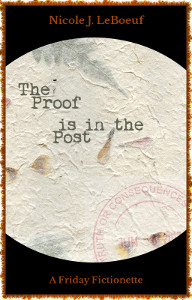
this fictionette proposes a new game that we can all play together
Sat 2018-01-27 02:13:51 (single post)
- 933 words (if poetry, lines) long
The wee hours of Saturday still count as Friday if I haven't gone to bed yet, right? Which was, for once, quite easy. Whenever I do several hours of work at a pub or bar, I feel like I should always be drinking or eating something to excuse my lengthy presence. And after two beers and two small plates, I was not up for more food or alcohol. So I ordered coffee. And of course they didn't have decaf. And of course I had coffee anyway. I may yet be up awhile.
And but so anyway please accept this Friday Fictionette as a token of my dedication to you. It is called "The Proof is in the Post" (excerpt available for all, full-length ebook and audiobook for pledging Patrons). It is about truth, and the risks of telling the truth, and how sometimes you don't actually know what your truth is until you hear it come out of your mouth--or until the post office imps helpfully edit your letters for brutal honesty and you see what comes out at the other end. Because that's how this version of the world works: The post office will not deliver a lie.
I had a lot of fun with the freewriting session that eventually turned into this story-like object. It was an exercise in worldbuilding. Supposing that any letter you send gets altered in the mail so as to correct inaccuracies, clear up ambiguities, and replace any lies, whether by commission or omission, with the truth. What are the implications? What does that do to communications, economy, contracts, paychecks, love letters, invitations? I had so much fun with the worldbuilding that I never actually came up with a plot. So this week I had to come up with a plot post haste. (Get it? Post haste? Because post office? See? OK. Right, so, anyway...)
I didn't expect the character to get so well fleshed out. I didn't expect to have to pause the audio recording because I suddenly got all choked up at the end because, dang it, she's me at fourteen and I feel for her very strongly. I want to reach out and hug her and assure her it's all going to be all right.
So that's the story behind the story.
Here's a story about the Friday Fictionettes project in general: I'm going to add a feature! If I remember come Monday, that is. I'm writing it down now so that I will remember. Let's see if it works:
On first through fourth Mondays, I propose to make a public post on Patreon sharing the writing prompt associated with the Fictionette that will be released that Friday. So you can play along at home. If you want, you can share your results in the comments. Then everyone can see how differently multiple stories based on the same prompt can turn out.
I mean, it looked cool when Chuck Wendig did it. Let's try it and see what happens.
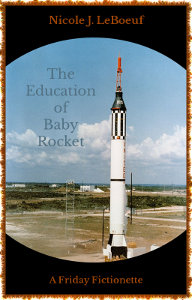
this fictionette had to make it up as it went along (and takes its waking slow)
Fri 2018-01-19 23:59:59 (single post)
- 1,337 words (if poetry, lines) long
On time this week, by a hair. "The Education of Baby Rocket" (excerpt for all, ebook and audiobook for Patrons) is now available for your perusal. It's about fear, mostly, but also homesickness, and what exactly we mean by "home" in the first place.
I lost a 4thewords battle for the first time today. Let it be known: Not a single loss until Day 67! Lesson learned: I can do 800 words in half an hour easy if I'm drafting but not when I'm revising. Second lesson learned: No naps with a battle deadline less than two hours out, Mr. Rabbit. That's how Mr. Tortoise beat you, remember? Alternately, don't start a two-hour battle if you think you'll need a nap before you're done.
Speaking of lessons, sometimes I think a writing life primarily consists of learning not so much a long series of lessons over time but rather a small handful of lessons over and over again. This is probably true of life in general, come to think of it. But it's certainly true of writing.
Here's the lesson I had to relearn this week: I don't know what I'm writing until I've written it.
It's less that I forget it and have to relearn it, and more that I keep discovering situations where it's relevant. Still makes me feel stupid, though. Like, "Ohhhh! The swimming pool is wet! Because all water is wet. Dammit, I knew that."
This week, the application was, Because I don't know what I'm writing until I've written it, not knowing what to write isn't a reason not to write. Also, and very importantly, "I don't know what to write" is a perfectly cromulent first sentence to write on a brand new fresh blank page. It helps lube the word-making engine, and I can always erase it later.
It came up while I was working on the Author's Note for "The Education of Baby Rocket." Well. That's rather overstating things. It came up while I was staring at the blank new document upon which I had tasked myself with writing the Author's Note. Staring at a blank page is not conducive to getting the Friday Fictionette released on time, but that's what I was doing: Staring at a blank page and thinking, "I don't know what to write."
Fun fact: Thoughts circle around and chase their own tails, but words written down are done. No amount of thinking "I don't know what to write" was going to get me anywhere. But typing "I don't know what to write" allowed me to move on to another thought, another sentence. It sort of forced me to really observe and acknowledge what I was thinking, you know? Like Morning Pages do. "I don't know what I'm going to write for this, so I'm going to just babble until I figure it out. I'll start by telling myself the story of how the writing prompt turned into the first draft, although that's not enough for an Author's Note by itself because really there's only so many weeks in a row the Author's Note can be 'here's the prompt, and here's how I got from prompt to story idea to first draft to finished story'...."
And off I went for, oh, several paragraphs. Three or four at least. Then something went click. I knew what I was going to write because by then I had already written it. Now I just needed to tidy it up and then delete the bits of babble that wouldn't be part of it. Don't get me wrong; that babble was essential. As in the Buddhist metaphor, it was the little boat that got me across the wide river that had separated blank page from finished draft. But it had done its job. It was no longer needed. I could leave it behind me on the shore and walk away.
As the poet said, "I learn by going where I have to go." As another poet said, "We make it up as we go along." I don't really have much to add to that except to testify that it's true.
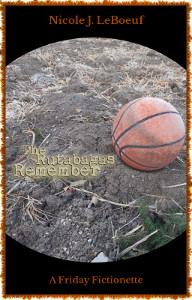
friday is the new friday
Fri 2017-11-17 22:31:16 (single post)
- 11,049 words (if poetry, lines) long
- 1,042 words (if poetry, lines) long
Sound the trumpets and ring the bells! This week's Friday Fictionette is out on Friday. Shock! Surprise! We are stunned! And also I've already made a solid start on next week's fictionette because--y'all are gonna get sick of hearing me say this--4thewords is 4theWIN.
And but so anyway. "The Rutabagas Remember" is about equal opportunity basketball. Kind of. It's also about making memories that matter. It's 1042 words long. It's available to $1/month Patrons as an ebook; to $3/month Patrons it's additionally available as an audiobook. The usual drill, in other words.
My original plan for cover art was to find public domain or Creative Commons images of a rutabaga and a basketball and kinda fade one onto the other. It looked really cool in my head. It also was going to be a pain in the butt. But that was my plan.
I'd just logged my morning NaNoWriMo session. I was about to have my lunch. First, though, I went for a walk around the neighborhood to figure out what I'd write during the evening session. Meantime I intended to start right in on fictionette publishing procedures soon as I got back and had a bite to eat.
While I was out, I stumbled across two things:
- A community garden left to winter over, just behind the nearby church.
- A basketball abandoned and left to rot on the shore of one of the little private lakes nearby.
Well. I'm not one to ignore the Universe when it is so very clearly talking to me. I grabbed the basketball, I grabbed my camera, I headed back over to the garden, and lo, a photo was born. It probably could have been a better photo. But it's mine, I took it, I made a cover design out of it, I'm sticking with it.
I mean, a basketball. Just lying there being thematically relevant.
Today went as planned in other ways. I logged two NaNoWriMo sessions which together netted me 3,385 words. It wasn't the 3,500 I was hoping for, but it was in excess of the 3,334-word double-day mark, and that's the important thing. If I can pull double days from here on out, I will win the prize.
And there is a prize. There's going to be a coupon code for 4thewords in the NaNoWriMo winner package; it'll be worth 50% off a core crystal purchase and it'll pop some exclusive NaNoWriMo-themed gear in your inventory. Details about this and more in the NaNoWriMo Forum on the designated 4thewords thread.
That Nano-winner gear will be mine.
(Also I have now defeated a whole bunch more monsters and I've completed the torch quest and a bunch of Nano-related word-count quests and some quests involving a checklist of marionette varieties to defeat and and and and I finally SUBSCRIBED, ok, I bought the big bulk package, I am IN THIS EVERY DAY for YEARS TO COME)
in which a tedious writing exercise becomes inconveniently interesting
Thu 2017-08-31 22:48:21 (single post)
- 1,136 words (if poetry, lines) long
The long blog silence is testimony to the truth of the adage "After derby is too late." Not a universal adage, admittedly, but a fairly reliable one in my little universe. So today I'm blogging before derby. Just before. Instantaneously before. I'm in fact sitting at the folding table in the Officials' Corner at our practice location, and I have until they arrive and need to actually use this table to get this blog post done. Go me!
(I think I will be able to manage posting it after derby. There is no wifi at our practice location unless I beg use of someone's smartphone uplink. And smartphones notoriously fail to get signal in our practice location.)
I found a little time earlier this week to play around with interactive fiction. In Melissa Ford's book Writing Interactive Fiction, I had just got to the Designing Agency section--it's pretty early on in the book, I'm not moving through it particularly quickly--and worked through the Beanstalk exercise. The exercise has, to my thinking, two purposes: It gives you more practice using Twine to give the reader/protagonist choices, and it focuses your attention on whether those choices are meaningful. If they aren't, the interactive fiction isn't.
The exercise was to write a sort of Jack and the Beanstalk... sequel? Alternate plot? Basically, the giant is threatening to come down the beanstalk and STEAL YOUR SISTER. Oh noes! The first scene must end with two options, and each of two ensuing scenes must end with two options, which means there will be four possible endings.
I was not enthusiastic about this.
(Oh, crap, it's 6:30 already. I have to go put my skates on. I will finish this after derby! I will!)
(And now it is 10:00 PM. I'm a little more bruised and a lot more tired than I was when I left off. Now... where did I leave off? Oh. Right.)
I was not enthusiastic about this. I had absolutely no desire to rewrite Jack and the Beanstalk, much less in four permutations. But that was my assignment, so, darn it, I was doing it.
Forty-five minutes and 1,500 words later, I had done it and it wasn't so bad. Having no love for damsel in distress storylines, I had worked every branch toward the revelation that Jack's little sister had become a soldier competent to lead an army. The reader's choices would determine where she and Jack stood as siblings. In one, they were teammates working together to defeat the giant. In another, they were enemies, traitor and betrayed, and Jack wound up exiled for his sins.
It was all very silly, but it still managed to capture my interest by the end of it. That night, on my way to sleep, I couldn't stop thinking about ways to expand the story into something actually worth reading. I could foreshadow the little sister's development into a warrior princess, for instance. I could tell how she'd practiced swordfighting and climbed every tree in sight so she could grow up as fierce and strong and brave as her adored big brother. I could note the foolishness of Jack treating the giant like a personal problem when in fact his little farm was part of a great big nation which the giant might rightfully be seen as invading. And what about the harp? Did she resent Jack for having stolen her during his earlier foray? Did she miss living up in the clouds? Was she the medium by which the giant delivered his threat?
And so on, and so forth. And what's ridiculous about it is, it's probably not going to be commercially viable no matter how well I revise and expand it. The entire premise is from an exercise in a well-known (I think?) book on the subject, which other aspiring interactive fiction authors have no doubt already worked through themselves, and there aren't that many markets for interactive fiction at this time. So I really shouldn't let myself obsess over it, at least not until I've got a bunch of other projects out of my hair. Like, say, the short-short I want to expand into an interactive piece that actually is commercially viable. Hey, brain, maybe we should obsess on that story, and not on this one, what do you say?
Darn it, Muse! You are so inconvenient!
*Sigh.*
Lastly, some quick fictionette news: The freebie for August 2017 has been released. It's "Tina, Destroyer of Worlds," and you can now read/download it as an ebook, an audiobook, or as a webpage via Patreon regardless of your patron status. Also I finally put the Fictionette Artifacts for April in the mail. I hope not to take so long with the ones for May. If I take a whole month to do each one, I'll always be three months behind, and that would be depressing.
kind of like the way pain just means you're alive
Thu 2017-08-10 00:12:13 (single post)
- 1,200 words (if poetry, lines) long
I've been thinking about interactive fiction. Specifically, I've been thinking about a particular short-short of mine, "Keeping Time," and how I might expand it into an interactive piece. I've actually been thinking about this for a couple years now, but it can take me a while to find myself a chunk of time in which I can do more than think about it. You know how Violet "invents" extra time for herself and her siblings to solve a mystery in The Wide Window by Lemony Snickett? I had to invent extra time for myself. Mostly by getting up earlier and figuring out how better to adhere to a daily writing schedule. So far so good. Deliberate invocation of allergic reactions was not involved.
And but so anyway: Interactive fiction, Twine, and me. Twine! "Twine is an open-source tool for telling interactive, nonlinear stories." I'm learning how to use it. I'm going about this the same way I went about learning PHP: By working my way, page by page, through a book about it. This book here: Writing Interactive Fiction with Twine, by Melissa Ford. Her book may or may not align with the kind of interactive story I want to tell, but it looks like it'll make me a competent Twine user, so.
"Keeping Time" is a very short story, originally under 700 words and later expanded to about 1200, about a character who flees Earth and travels via dimensional portal to other worlds, hanging on tight--despite radically changing environments and perspectives--to their identity and humanity for as long as they possibly can. In its current form, it has five scenes that act as a sort of montage portraying the journey and the changes the character undergoes along the way. As a piece of interactive fiction, I want it to have more scenes--that's a no-brainer--but not necessarily more endings. I want it to be a sort of many-roads-lead-up-the-mountain thing. The ending is sort of inevitable, to my mind, but how one gets there, and how many different worlds one experiences on the way there, and how those influence the remainder of the journey by changing the character either according to or against their will--that's where the choice and variety comes in.
So, less of a Choose-Your-Own-Adventure and more of a roller coaster ride with decision points. You get on and off the ride at fixed places, but the shape of the ride from one to the other is up to you.
(Actually I have just thought of an alternate ending. But I'm not going to go into that just now because spoilers.)
You may or may not have seen my old Choose-Your-Own-Adventure Story Engine? One of my earliest HTML/PHP projects. It's over here, and you can play with it, but be warned it is probably overrun with spam and awfulness right now because I've been an absent moderator lately. (Note to self: get on that.) Anyway, it's an editor and repository of very simple interactive fiction. The first page ends in a choice. Each choice leads to a new page. Each new page ends in a choice or possibly THE END. Anyone can add onto what went before, so it's interactive and potentially collaborative.
That is not what I want to do with "Keeping Time." I want to do something more like what Michael Lutz does with "my father's long, long legs." And I don't just mean the difference in formatting--the difference between interspersing blocks of story with "What do you do next?" on the one hand, and, on the other, presenting choices as hyperlinks from within the story proper. I mean, the variety of ways the choices are used. What the choices are for. Sometimes, the hyperlinks simply advance the reader to the next part of the story--a way to turn the page. Sometimes they act as footnotes--an invitation to examine the hyperlinked concept in more detail. Sometimes they're decision points which will change the story, or your path through the story, irrevocably. Sometimes they're more like scenic bypasses, or branching, braided streams that take a detour around farms and fields before rejoining the main river. There's a lot of complexity there, many different ways of shaping reader experience. Or, rather, many different experiences to let the reader choose.
Also it never stops being a story. Interactive fiction straddles the line between "story" and "game," with some examples falling more to one side than the other. The exact placement of that line, and what falls on which side of it, is subjective. I want to create something that's still very much a story, not a game--at least according to my version of that line.
On another note: The more I think about this story, the more ideas I get, the more ambitious the whole project becomes... and the more terrified I get of taking it on.
This is worth noting: When I become afraid of a (writing) project, that's generally a sign that the project is worth doing.
Can I please progress to the point where fear turns into excitement and I stop eating my own stomach lining? Please? I would like to get to that point tomorrow. It would make my writing life a more comfortable place. And I would like it to be a comfortable place, seeing as how I intend to spend a lot of time there.