First Breath
2850 words long
in which the author looks back on 2022 and realizes she was not entirely unpublished therein
Wed 2023-01-11 22:21:06 (single post)
- 2,850 words (if poetry, lines) long
- 25 words (if poetry, lines) long
- 14 words (if poetry, lines) long
- 3,453 words (if poetry, lines) long
At least one post per week: Check. I have not been uniformly On The Ball since last post, but this much I can do.
This week's post will be my "what I had published last year" roundup. It will be fairly short, because 2022 was not a great year for writing new things or submitting regularly. But there were some things published:
New poetry: "On the Limitations of Photographic Evidence in Fairyland," Eternal Haunted Summer, Summer Solstice 2022 (theme: Other-Than-Human Realms).
In fairy folklore, there's a story that turns up now and again involving a human who gets invited into Fairyland to perform some necessary function, and has to have magic ointment applied to their eyes in order that they might see true while they're there. Much later, after their return home, a fairy looks them up in their day-to-day and asks them, "Which eye is it you see me out of?" Turns out they did an imperfect job of removing the magic ointment, which means they've got a loose end to tidy up. Can't be having random humans going around able to see fairies clearly! So the human answers, "The left eye," and the fairy says "Cool, thanks," and immediately puts out the human's left eye. As opposed to dunking them in a handy ditch to just, y'know, wash the ointment out. Because fairies are cruel and capricious and, above all, dramatic.
Anyway, I wanted to play with that trope, such that the "eye" that had to be put out was the photographer's camera (the photographer's services having been engaged for an important fairy wedding). The fairy would smash the camera, and maybe even blind the photographer (see above: cruel and capricious), but of course the photographer still has the negatives, which they would pass down to future generations along with the story of the photographer's adventures.
One day I will actually write that poem. Or story. It could be a story. In any case, it wasn't what I wrote in time for this submission deadline. I wrote this other thing instead.
Reprint poem: "Reasonable Accommodations," The Future Fire issue 2022.62
My poor little corporate weredeer first appeared in Departure Mirror Quarterly Issue 2 (Winter 2021). You can still download that issue, but you'll have to do it from the Internet Archive "Wayback Machine," because the publication sadly had to close its doors before Issue 4 came out. In which issue, incidentally, another poem of mine they'd solicited had been set to appear. Alas. That poem remains unpublished, and not for want of my sending it out. Maybe 2023 will be its year.
Reprint story: "Survival, After," Apex Magazine 2021 (or via Weightless Books)
Originally published and podcast by Apex Magazine in August 2021, this story was included, along with every other story they published in 2021, in the magazine's yearly anthology. I understand it's their biggest table of contents yet! There's lots of amazing stuff in there that quite frankly blows my little tale out of the water, so it's well worth the price. Yes, you could just go read all the stories for free on the website, but the print anthology, in addition to being extremely convenient in providing all the content in one handy codex (no need to click all over the place! Just turn the pages!), is a truly gorgeous artifact. It would look beautiful on your bookshelf or your coffee table.
Reprint story: "First Breath," penumbric speculative fiction mag vol vi issue 4 (December 2k22)
Originally published in Ellen Datlow's vampirism anthology Blood and Other Cravings (Tor Books, September 2011), this is my most reprinted work--less because of its classic staying power, I think, and more because it's the story I keep sending out in hopes of getting it reprinted. But this is its third outing (not counting its debut) so I guess editors like it. (Previous reprintings: Denver Horror Collective and the Tales to Terrify podcast.)
I'm saddened to discover the purchase pages for the original anthology are gone. But I suppose every anthology must go out of print sometime. You can still find copies via that online retailer named for a river in South America, because of course you can, but it's no longer available via Macmillan Publishing or Barnes & Noble that I can see. So instead I've linked the Publisher's Weekly write-up, which actually name-checks me (I was a "newcomer"! I arguably still am) so that's kinda cool.
I suppose that will be one of my 2023 goals: Get "First Breath" reprinted again.
Anyway, that's the 2022 Publications Roundup. As you run off to click the links and check them out, do check out the rest of the relevant issues (or the relevant year, in the case of Apex). There's some great stuff in those tables of contents, written by some enormously skilled wordsmiths, and you need to get your eyeballs on 'em STAT.
Until next week!
you can read the thing and listen to it too
Tue 2021-08-03 22:54:47 (single post)
- 2,850 words (if poetry, lines) long
- 3,453 words (if poetry, lines) long
Today is the happy day! My story, "Survival, After", is now live on the website of Apex Magazine. The issue it's in debuted some weeks ago for subscribers to read in its entirety, but today my story became available for all and sundry, subscriber or not. You can read it here.
You can also listen to it at that link, too! Or via the page for Apex Podcast Episode #80. I'm thrilled beyond words not only for KT Bryski's brilliant production of the episode, but also for her giving me the opportunity to read the story. This is my first time doing fiction narration outside of my own Friday Fictionette Project--reading fiction on someone else's podcast, how about that?!--and I'm so grateful to be given the chance.
In other writing news, my most-reprinted story and first professional sale, "First Breath," will be reprinted again! But not for a little while yet. I've signed the contract, but the magazine has a lead time of a good handful of episodes. I'll give you more details as we get closer to release date.
And in writing process news.... this week is weird. Last week was weirder. The week before last sucked. Over the years, I have constructed this huge, detail-oriented edifice of rituals and routines in the service of Getting The Work Done, and it has, for the most part, worked--but sometimes, depending on how much avoidance and/or executive dysfunction I'm suffering, that edifice turns into a barrier. Like, "Oh, shit, it's almost 10 AM. I should be writing. But I'm going to have to do nothing BUT write, no distractions, for twenty-five minutes at a time, which sounds like an AWFUL act of penance. And also I need to set up my timesheet, and also before I can get to the Overdue Thing I have to do the Daily Things That Come First, with all the rest of the rigmarole and hoops to jump through, and--hey, how about I just play this stupid clicky game for another half hour? And another half hour after that..." And that's how the whole day goes, for days at a time. And that's what week before last was like.
Don't get me wrong--like I said, the edifice of routine and ritual usually works. It's structure, and I need structure. Without structure, my day tends to float away from me. But sometimes structure is itself the thing that avoidance accretes to, like barnacles on a sunken ship's hull. And when that happens, I can do one of two things: I can try to muscle through somehow, or I can say "to hell with timesheets! To hell with the daily order of operations!" and just, y'know, open the file of the Overdue Thing and start doing it, self-discipline optional.
So my timesheet is still on timeout. The order of operations has returned, sort of, but it's an informal checklist rather than a clock-scheduled list of tasks. And I'm allowed to just drift between the task at hand and the stupid clicky game if I want. Look, when some of the avoidance arises, stupid as it sounds, from "oh, no, getting started on the next writing task means putting away the mindless clicky game for twenty-five whole minutes," it's amazing how much of that avoidance simply evaporates if I give myself permission to keep messing with the mindless clicky game while doing the writing task. Write a few sentences, click a few things, write a few sentences more. Like that.
Like as not, the way it turns out, once I start the writing task, the writing accrues sufficient momentum of its own to make me totally forget about the mindless clicky game after all.
Brains! How do they even brain?! I dun geddit, y'all. But whatever. We work with what we've got, or we don't work at all. And the work has to get done somehow. So here we are.
And now it's time for another bowl of the crock-pot posole that's been happily simmering away since noon, and that has been on my mind ever since tonight's roller derby practice started. I tell you what, you want that happy warm emotional hug of "Somebody loves me!" when you walk in the door after a long and tiring day, you want to get yourself a crock-pot and a recipe for something long-simmering and hearty. It's a really lovely feeling.
we pause in our endless slog through the Great Overdue for some good news
Thu 2019-08-08 23:58:50 (single post)
- 2,850 words (if poetry, lines) long
So I've spent the last week or so getting even farther behind and am now in the middle of a frenzied new push to Do All The Things Every Day, which is why you're getting a blog post again at last.
I did say I'd let you know when the latest reprinting of my story "First Breath" was out, didn't I? Well, as of... er, about a week ago, actually--sorry?--it's out! The Denver Horror Collective is soon to release their local horror anthology, Terror at 5280', and in celebration of that they're posting some stories to their website ahead of release day. My story is not in the anthology proper, but it's part of the run-up festivities, and you can read it here.
In other very pleasant news, I got an acceptance response to a recent poetry submission. Since nothing's real until contracts are signed, further details will have to wait until probably September. But the acceptance letter was definitely real, for pre-contract values of real.
For those keeping count, we're up to three acceptances in 2019, two of them poetry. The poem that just got accepted, I more or less wrote on the bus from Boulder to Longmont. Clearly I should be writing more poetry.
In case you're interested in how the submit-every-day, get-100-rejections challenge is going, I shall paste in the table with all the 2019 numbers. They are good numbers. I am quite proud of them.
| Jan | Feb | Mar | Apr | May | Jun | Jul | Aug | Total for 2019 (so far) | |
|---|---|---|---|---|---|---|---|---|---|
| Submissions: | 0 | 0 | 3 | 10 | 23 | 20 | 23 | 8 | 87 |
| Rejections: | 1 | 0 | 0 | 3 | 13 | 19 | 17 | 8 | 61 |
| Acceptances: | 0 | 0 | 0 | 0 | 0 | 1 | 1 | 1 | 3 |
In other news, revisions continue to be hard, and Friday Fictionettes continue to be way behind schedule. More about that quite possibly tomorrow if I manage to Do All The Things again.

the hardest working little story in my stable
Wed 2019-07-10 23:50:32 (single post)
- 1,129 words (if poetry, lines) long
- 2,850 words (if poetry, lines) long
- 1,362 words (if poetry, lines) long
So this blog post is mainly to announce that my short story, "First Breath", will be reprinted again. I'm not sure exactly when and I don't think I'm at liberty yet to say exactly where, but I have Signed a Contract so it's pretty darn definite.
I'm tickled to now be able to call this story "my most reprinted story." It will have been reprinted a whole two times. Go little story, go! On the other hand, I'm less than impressed with myself; my last two prose sales--that is, counting only short stories, not poetry--have been reprints of this story. And while I remain quite proud of this story, it first saw print eight years ago, you know? I've been writing all sorts of things since then! I would very much like to get an acceptance letter for a new thing! It would help reassure me that I am still capable of writing publishable stories!
But I'm not complaining too hard here. Yay, a second sale in 2019! The numbers game works!
Speaking of the numbers game, here are those numbers:
| Jan | Feb | Mar | Apr | May | Jun | Jul | 2019 | |
|---|---|---|---|---|---|---|---|---|
| Submissions: | 0 | 0 | 3 | 10 | 23 | 20 | 8 | 64 |
| Rejections: | 1 | 0 | 0 | 3 | 13 | 18 | 4 | 39 |
| Acceptances: | 0 | 0 | 0 | 0 | 0 | 1 | 1 | 2 |
Meanwhile, I'm still behind on all things Fictionette. But as of Monday, the Friday Fictionette for June 28th is up: "Right on Time" (ironic title, that--ebook here, audiobook here). Like many stories, it's about how things can always get worse. In this case, things get worse when the wrong miracle happens to the absolute most wrong person. Also, as of today, I've released the Fictionette Freebie for June 2019 to the world at large. You no longer need to be a Patron to access the Friday Fictionette for June 14, "Love in the Time of Lizard People".
I have a whole 'nother rant in me about how REWRITING THINGS IS HARRRRRD but how about we save that for tomorrow? Yeah, lets.
rejections += 1 (yay) and so do submissions
Fri 2019-04-26 23:57:37 (single post)
- 2,850 words (if poetry, lines) long
- 1,285 words (if poetry, lines) long
I got a rejection letter today! That makes four of the one hundred I want to acquire in 2019, and the first in response to the avalanche of daily manuscript submissions I began sending out mid-April. It's working, it's working!
Meanwhile, Hi. I'm in a hotel room in Eagle, Colorado. Tomorrow I skate with the Boulder County Bombers "All Stars" in the Melee in the Mountains tournament. Our first game, against the Chicago Outfit, will be at noon. And I am super tired and ready for bed.
It doesn't help that I just walked down to the Park 'n Ride to retrieve my car from where I left it charging at the free public charging station, only to discover when I got there that I'd left my car keys in the hotel room. So I decided the car can just stay there until tomorrow morning. I'm not unhappy that I went for the extra walk, though. Walks are nice.
But now I'm really tired. Therefore the rest of today's writing update will be super fast and super brief.
Ahem.
- Still way behind on the Friday Fictionettes, but I got a decent nibble in just now on the one for April 19.
- I kept up my daily submitting streak. Over lunch, I sent "First Breath," with its Colorado ski-town setting, to a Denver-centric anthology that might reprint it.
- Over meatloaf at the Eagle Diner, I managed a brief talk-to-myself session on the current short story revision.
- Also at the diner, I did some similarly brief freewriting, resulting in what looks like a solid "zero draft" for a brand new short story.
To be painfully honest, I have to admit to overestimating my submission streak the other day. At the time, Habitica reported a 9-day streak on that particular daily task, but it's very generous in preserving my streak so long as I use my Rogue powers of stealth to avoid damage from uncompleted dailies. Looking at the Submission Grinder, I see that today's submission brings me up to seven days of daily manuscript submissions, one each weekday from April 18-26 inclusive. Also I did one April 16. So it's not like the ongoing achievement loses any impressiveness after the correction. I'm still pretty damn pleased.
So. Today I did a Boulder Food Rescue shift, packed for a weekend trip, and drove three hours from Boulder to Eagle, and I still managed to do all my weekday writing things. That's pretty darn cool. Here's hoping I can do the same Monday despite Saturday's tournament, Sunday's drive home, and Monday's much-needed recovery activities.
Days 3-5: In which we arrive, share some good news, and make plans to depart once more
Mon 2018-11-05 23:57:27 (single post)
- 2,850 words (if poetry, lines) long
- 3,453 words (if poetry, lines) long
So remember when I said that my first pro sale, "First Breath," would be on the Tales To Terrify podcast this year sometime only I had no idea when? Well, it's up now! It went up on October 12 in Episode 350, and you can listen to it here.
I had the weirdest reluctance to listen to it. Well, maybe not so weird. Maybe it's related to the way I have to leave the room if someone is reading something of mine; if I stay there, I'll be on pins and needles, trying to read reactions into every shift or sigh--"They yawned. Are they bored? They keep recrossing their legs, are they uncomfortable? Do they think I'm a freak because I thought up stuff like that and put it in a story?" I guess I had similar discomfort with the idea of hearing someone else read my story out loud. In my gut I was sure that, hearing it, I'd finally see what an awful, stupid, shameful thing I'd written and put out into the world--
Stop that, I told myself; you know perfectly well that a prestigious editor already thought this was worth putting in an anthology. And this is a Hugo-nominated podcast; its editor clearly has good taste--and he chose to run your story. Your story has not suddenly become awful. Press play.
I listened to the episode on my drive out of Avon Sunday morning. My story comes first, narrated by Michelle Kane, and she does a good job. I mean, I have quibbles, as I expect I would no matter who read it because it's my baby and they're not me; but they're only quibbles, and not worth going into. Most importantly, I was gently crying by the end, so, go her, and go me.
Thing about that story is, I keep forgetting it's a horror story, and, moreover, a vampire story, or at least it has a sort of vampirism at its heart. I didn't write it with vampires or the horror genre in mind. But it's clear the vampire aspect was a factor in the choice of story to pair it with: Victoria Glad's "Each Man Kills," originally published in Weird Tales in 1951. Now, there's a vampire story, one springing from under the cape of Dracula himself.
Anyway. I hope you get a chance to wander over and take a listen.
Time now for the NaNoWriMo Rebel report, covering today and the weekend we just left behind us. The short story is, I'm still at 100% on my self-challenge. Here are the details.
Morning Pages: (Weekdays only.) Did them today, but lollygagged on my way there. It was like I couldn't bear to admit it was Monday. Used them mostly to make sense of my vague sense of dread about all the things I had to get done today: it's my first full day back in Boulder, but also my last full day in Boulder before I leave again, so we're back in travel prep stress mode. It helped to write down the specific things I had to do, make a concrete list of them, and make a plan to hit each one. It made the scary big cloud of dread into an achievable agenda.
Freewriting: I'm happy to report that I did this faithfully each day of the weekend as well as today. But I'll admit that on Saturday and Sunday I put it off until almost the end of the night. Saturday I actually played Puzzle Pirates again--my crew on the Cerulean Ocean was defending an island, and I wanted to help. After four rounds, I pulled myself away and got to work. I had to put off all my writing work until evening today, too, but for a better reason--I had to prioritize some travel prep errands first.
Over the weekend I began using the 50 Creative Writing Prompts at NowNovel.com. This is a series of exercises for focused writing practice. They feel a little like classroom assignments. They remind me of working my way through Ursula K. LeGuin's Steering the Craft, which was also full of classroom-like exercises for focused writing practice. I did exercise 1 on Saturday and exercise 2 on Sunday.
Today's writing prompt came from Chuck Wendig's series of flash fiction challenges; I've been working my way backwards through his archive, doing one a week. Here's the one I did today.
Fictionette Development: Pretty much part of the same writing session as freewriting over the past three days. Each session was kind of small, in keeping with the philosophy of "at least do a little." By the end of Sunday I had finished the Monday Muse post and set it for scheduled release--I love it when I can do that, it means I am perfectly on schedule--and today I babbled to myself on the page about what the piece due Friday will look like.
Commercial Fiction Production/Revision: (Weekdays only.) More babbling. Made a list of questions that would have to be answered as I expanded the original flash piece into a full-length story. May have encountered some answers along the way. Will have to sleep on it.
Submission Procedures: (Weekdays only.) So, about Friday. You know how I said it was late and I wasn't going to do anything more than just think about where to send "Survival, After" next? Well, turns out, I figured out where to send it next--and discovered that they'd be closing to submissions Saturday afternoon. So I sent them the story then and there. Go me!
Today was just for record-keeping. Logged that "First Breath" was now published at Tales To Terrify; logged that the place I sent "Survival, After" had sent an acknowledgement of the submission. Pretty much left it at that.
Blogging: (Weekdays only.) And there you go.
Tomorrow's work day will be prioritized according to what must be done before I get on the train, which is to say, while I can still access the internet. So Tuesday's blog post should show up sometime in the afternoon rather than stupid-o-clock at night. At least I won't have to stress about getting in my daily 444 on 4thewords.com; since I have continued writing this post well after midnight (its date stamp notwithstanding), I've extended my streak through Tuesday the 6th already. That's a relief. However, I'm currently battling a 24-hour 3,000-word monster, and I'm not finishing that sucker tonight. Guess I'll have to blog it to death from Denver Union Station tomorrow afternoon.
'Til then!
the rest of the story about the other story sale; also the whole story about this solstice
Fri 2017-12-15 00:33:19 (single post)
- 2,850 words (if poetry, lines) long
Regular readers of this blog will remember me making happy yet vague noises recently about having sold two stories for reprint. I was finally able to share more information about one of them Tuesday night, the publisher having given me permission that day to do so. Well, the publisher buying the other one got back to me today; therefore, this announcement:
"First Breath," originally published in Ellen Datlow's Blood and Other Cravings anthology, will be podcast in 2018 by the audio horror fiction magazine Tales to Terrify. Tales to Terrify is part of the District of Wonders Podcast Network, including also Far-Fetched Fables and the Hugo Award winning StarShipSofa. If you take a listen to any of those podcasts, I think you'll agree that the prospect of hearing my story produced by one of them next year is very exciting.
I don't know exactly when in 2018; the podcast schedule is not yet set. Once I know, I'll pass the happy knowledge on.
In local news, we're planning to hold our semi-traditional Winter Solstice Yule Log Vigil and All-Night Open House between the hours of sunset on Wednesday, December 20 (when we set the yule log on fire) and sunrise on Thursday, December 21 (when I and anyone else still around and awake will briefly cheer for the victory of the Sun after the passing of the longest night before finally falling asleep). If you are reading this and you'll be around, come on over for as long or as little as you'd like. No need to RSVP. Ping me for the address if you don't already know it.
In terms of clock time, Google tells me that sunset on the 20th will be at 4:39 PM, and that sunrise on Solstice morning will be at 7:20 AM. When I make the Facebook event page tomorrow, that's how I'll fill in the blanks for start and end times.
Considering what I've got for a yule log this year, I suspect it won't last the whole night through. But we've got plenty of other firewood to burn, so it's cool. Don't worry, Sun! We won't let the fire go out! We're here to help you get home!
I will cook some collection of yummy seasonally festive things. Potluck offerings of food and drink happily accepted but not required. The board game collection will be available. Fibercrafts will likely happen; feel free to bring yours and spin/knit/crochet along. If folks want to have a story-telling/read-aloud thing happen, that would be seasonally appropriate too. I will warm up the Rock Band set and place it at everyone's disposal. I'll have a Solstice music playlist for back-up tunes. There might even be roller derby footage watching. I mean, consider the likely majority demographic.
What there won't be is a lot of writing. I mean, not from me. Not regular workday writing. I expect I'll do enough to keep up my 4thewords streak, but for the most part Wednesday and Thursday will be holidays for me. Besides, there's no way I'm going to get a full work day in and also prepare for the party and/or sleep off the all-nighter. (Which isn't to say that, should a bunch of writers come over who were inspired to hold an impromptu write-in, I'd say no. I would definitely not say no to that.)
In some previous years, I've held out an open offer to drive carpool to Drumming Up the Sun at Red Rocks. I am emphatically not offering that this time around. I'm trying to ease my way back into this after taking a couple years off. It wouldn't do to bite off more than I could chew. But if you want to take in the most spectacular sunrise you're likely to see all year in company of a couple hundred Denver-area Pagans, that's going to be happening Thursday morning. You'll want to get to Red Rocks at least a half-hour before sunrise if you're doing that.
And that's the news, and I am outta here.
no crashy-burny for THIS fictionette; also, how the sausage gets made
Fri 2017-07-21 23:47:11 (single post)
- 1,031 words (if poetry, lines) long
- 2,850 words (if poetry, lines) long
The bad news is, yes I got sick again. Or discovered I'm still sick, and that Thursday was just a day off from being sick because the universe is merciful or because it likes a good joke or maybe just because I took a 12-hour Sudafed at exactly the right time, I don't know. Today was gross sniffly coughing sneezing bleaaarrrrrgh.
The good news is, I got all my work done anyway. So there. Take that, sick! You ain't the boss of me!
Seriously, though, 100% not kidding, today was probably a more powerful rebuttal to Jerk Brain than it would have been had I felt perfectly fine. It's evidence that my ability to Be A Writer™ is not dependent on the stars being aligned just right. It is something that, in all but the most exceptionally terrible cases, is always within reach. That's really empowering.
Today I...
- Sent "First Breath" off on a new quest for reprint publication
- Published this week's Friday Fictionette
- Set up a Scrivener project for converting an old draft into a new piece of flash fiction
And also freewriting, Morning Pages, this blog entry, Fictionette Artifact catch-up, yadda yadda yadda. ALL THE THINGS.
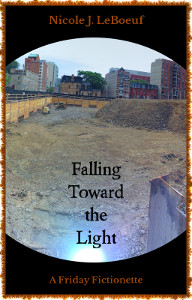
The Friday Fictionette for July 21 is "Falling Toward the Light" (for Patrons: full-length ebook, audiobook), which is mostly about the hazards of having a rift in the space-time continuum open up while excavating for new building construction in downtown Loveland. It's also partly, possibly, between the lines, about the effects of the above on economics and politics at the hyperlocal level.
When keeping up with Friday Fictionettes was threatening to take over my entire writing life, I was beginning to question their viability as a continuing side project. I was sick of having nothing writing-wise to blog about except them. But now that I'm more or less caught up and reliably on time with the weekly releases (excluding, of course, the Fictionette Artifacts--I am almost ready to mail the ones from March), and now that I'm regularly working on writing and selling short fiction again, I'm going to designate Fridays and only Fridays for blogging about Friday Fictionettes. To everyone's relief, mine especially.
And now that they've been reliably on time for a few weeks, I feel like I can speak to the weekly routine of making them happen. So! Here is my Process, in case you are wondering.
Saturday: Tomorrow's Saturday! Yay. It is the Saturday preceding the July Week 4 release. So I'll take a look at what I wrote during my freewriting sessions during the fourth week of June and choose one of those pieces to develop into the Friday Fictionette for July 28. I'll copy it from the Daily Writing scriv to the Friday Fictionettes scriv, then set up its folder with all the relevant templates. That's pretty much it. It's the weekend, and I just valiantly published the previous release, so I get to take it easy.
Sunday: NOTHING. I started giving myself this day off from even the most minimal writing tasks after I was forced to recognize I wasn't doing them. Something about starting the day with a three- or even six-hour roller derby practice. I've still been optimistic enough to set up writing dates with friends on Sunday afternoons, though.
Monday: Back to work. Once in a while, I'm fortunate enough to have produced a pretty good first draft during the original freewriting session. Most of the time, I'm not, and the output will be this rambling exploratory babble. So I'll spend Monday's fictionette-prep session just creating a very wordy outline. It's mostly about structure: Start here, then this happens, then that, then the other, then finally end with this.
Tuesday through Thursday: Write the dang thing. Using the outline as a sort of fill-in-the-blank, using the weave-and-dodge strategy to keep from getting stuck, trying not to waste any of my daily 25-minute fictionette-prep session on staring into space or doing too much internet research. This is the hard part but it's getting easier.
Friday: Publish the sucker. Come up with a title and an author's note if I haven't already. Ditto cover art. Sometimes I have all the foresight and I create the cover from my own photography or drawings, but usually I do a last minute search for public domain or creative commons attribution/share-alike commercial-OK licensed imagery. Export the Fictionette as PDF and epub, convert epub to mobi, record the audiobook and convert to mp3, and post to Patreon. If by this time it is not stupidly late o'clock, do the excerpts for Patreon, Wattpad, and my blog too; otherwise, do those over the weekend. (I try not to have to leave them for the weekend.) It sounds like a lot, but everything after creating the cover art is pretty mechanical by now. It only takes forever if I didn't finish the actual writing by Thursday.
And that is how the sausage gets made. The end.
See you tomorrow for the weekend YPP report! Or, if that's not relevant to your interests, skip it and I'll see you Monday.
outmoded, inconvenient, messy, elegant, satisfying
Wed 2015-07-15 23:37:55 (single post)
- 1,141 words (if poetry, lines) long
- 2,850 words (if poetry, lines) long
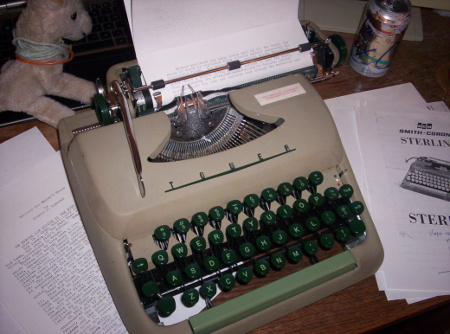
Pictured here is my second-hand typewriter, a Sears Tower which appears to be identical to the 1950s-era portable Smith-Corona Sterling. I bought it from a co-worker back in the late '90s. Then, upon my lamenting that it had features I'd no idea how to use, I was sent a copy of the Sterling's owners' manual by a Usenet acquaintance who guessed my typewriter was largely the same as his. (This was before it was trivial to find PDFs of owners' manuals of just about everything online--though, admittedly, I haven't found the exact document my friend sent me. This is the closest match I've located. My typewriter doesn't have those CL and SET buttons on the right.) That gift empowered me to use the ingenious Page Gage (sic) feature to get consistent bottom margins every time. It's a seriously clever thing.
Five years ago, this typewriter was instrumental in drafting the first recognizable version of "First Breath." This week it'll be key in fulfilling some long overdue Patreon pledge rewards. I owe two, soon to be three "fictionettes in your mailbox" to my $5+ tier patron. This is where, at the end of the month, I type out one of the month's fictionettes, correct some of the typos with white-out, watercolor and scribble and sketch on it, and send it off with my thanks.
At the moment, I am offering this thank-you to the first ten $5+ patrons. That may have been overly optimistic. I am thinking of lowering that maximum to five. A thousand words feels a lot longer on a typewriter than on a laptop. Accordingly, I find myself sometimes revising on the fly and cutting out phrases that no longer seem absolutely necessary. Or rearranging phrases because I got ahead of myself and I am not going back to correct it.
Also, mastering the Dvorak keyboard layout seems to have come at the expense of being able to touch-type in Qwerty. So I do a lot of looking up and looking down between the computer screen and the typewriter keys and the typewriter output, and losing my place in the original document, and shit there went the 1-inch marker on the Page Gage about two lines ago, I guess the bottom margin is going to be a little smaller than planned...
I'm not really complaining. I'm just griping. The difference is, complaints are meant to be actionable but griping is only recreational. I don't seriously want not to do this. I'm enjoying the exercise--reacquainting myself with the typewriter, producing a literary artifact, enjoying the messy elegance of the results (it's not the most precise instrument, this Tower), and creating a physical object as a token of my appreciation. And sending it in the mail! Having an excuse to mail physical letters is wonderful. It's inconvenient and outmoded and I love it. I'm in love with the written word in all its forms. Look, I do my morning pages with a fountain pen. Of course I love the typewriter and the U.S. Post.
Anyway, I intend to finish the May mailable tonight and maybe produce tomorrow the one that was due at the end of June. That'll will put me back on track in time to type up the July mailable at the end of the month. Huzzah! Getting caught up is the best!
and it's no wonder i sleep so late so often
Thu 2015-07-09 00:27:57 (single post)
- 2,850 words (if poetry, lines) long
As if I don't have enough to work on already, I got up this morning in a terrible excitement about two brand new story ideas, straight out of dreams. That's a gift. That's a precious, unlooked-for gift--the dreams themselves, handing me the kernels of new stories on a silver platter, but also the excitement. Excitement about a new story--it's been way too long since I've felt that. That's absolutely a gift.
It's also very much a mixed blessing when I'm trying to get other things done. Thanks awfully, subconscious!
In one dream, all the statues had come to life, humans alongside animals both fantastical and mundane passing through the city as animate marble, cement, iron. As the bus I was riding on passed through a neighborhood full of old oaks, we saw a big old house whose decorative copper-verdigris fence was waking up. Green deer were untangling themselves from the knot the artist had worked them into, and were picking their way over and around their fellows out onto the sidewalk. Suddenly the neighborhood was full of deer, centaurs, and men and women on horseback, all the color of copper verdigris. "Look," I said to John, who was sitting next to me on the bus, "it's the perfect color for them."
In another dream, an owl I thought I'd shot dead in a careless and much-regretted moment turned out to be alive after all, but the relief of that turned into horror when it changed shape to reveal itself a nefarious spirit in disguise, to whom we both would be in thrall until it finished feeding off of us and we died.
"I had these wonderful mythopoetic dreams this morning," I said to John, "one of them a pure delight and the other a fantastic horror movie. I can't wait to make them into stories. All I have to do is excise all the Daffy Duck bits and give them more of a narrative shape."
"Daffy Duck bits" are the parts of the dream that are too banal or just too silly for the story the dream inspires. My calling them that comes from the dream that gave rise to the short story "First Breath." The dream's main plot repeated itself, as dream elements often do. The first time, I was in a crowd of people in a large cave, and someone pointed out to me a figure in a grey hooded robe. "Don't let her touch you," I was told. "You mustn't let her touch you." Or what? Or she'd become me, and I'd become nothing at all. I ran and ran through the caves, the hooded figure getting closer all the time... Then the chase scene started over, but with an oblivious and sputtering Daffy Duck in my place, comically falling hip-deep into a hole and asking the hooded, robed figure to pull him out.
As you might expect, Daffy Duck appears nowhere in any draft of the story, let alone the version published in Blood and Other Cravings. Similarly, there's some utterly ridiculous things in my dreams from this morning. Some of the verdigris centaurs were cobbled together backwards, such that their human halves face their horse's asses. And when we attempted to lock the owl-demon out of our house, it ran pipes up through the floor, spewing a noxiously yellow sleepy gas into the house to knock us out so it could gain entrance. Which we knew because the gas left a yellow stain wash up and down my legs. Also there was frozen corn defrosting in the oven that happened to be built into the back wall of our bedroom... See? Daffy Duck bits.
Regardless, so much of both stories is already there, fully formed, in the dream. Not an occurrence I can plan for. All I can do is be grateful when it happens. I certainly can't complain, except maybe a little about the timing.
Dreams are awesome! They're what make sleep worth it!